

Posted by Netblaze Digital

Will that chest fit the wall, and will you still be able to open its drawers? Chest of drawers dimensions are usually given as height, width and depth, but the space around the unit matters too. Many South African models sit near 100 cm high, 85 cm wide and 48 cm deep, though real examples vary.
We analyzed 27 comments and questions from YouTube and Quora about the chest of drawers dimensions and found that 33% mentioned clearance allowances for drawer fit.
Measure the room and delivery route before you choose. We’ll explain what each measurement means, how drawer layouts affect storage, and which checks can save you from a tight fit.
What chest of drawers dimensions measure
A chest’s listed dimensions describe the outside of the assembled unit. Height runs from the floor to the top surface. Width measures across the front, while depth measures from the front edge to the back.
These three numbers tell you how much floor and wall space the chest will use. They don’t tell you the size of each drawer. Drawer space is smaller than the full outside dimensions because the frame, sides and back take up room.
Check how the seller orders the measurements. Some listings show width by depth by height, while others put height first. Look for labels beside each number instead of relying on the order alone. If you’re unsure, confirm before buying.
Also check whether the dimensions apply to the assembled furniture or its flatpack cartons. A chest can fit its final place but still be hard to carry through a narrow passage while assembled. For flatpack furniture, carton size can matter just as much as the finished unit.
Our Lagos chest of drawers measures 110 cm high, 62 cm wide and 43 cm deep. It weighs 39 kg and has six drawers. You can compare those figures with your room measurements on the Lagos flatpack chest of drawers page.
We make our flatpack furniture in Graaff-Reinet, South Africa. When you’re checking assembly needs, look for the included hardware and instructions. Our self-assembly support also includes video guides.
Think of the measurements as the unit’s outer footprint, not its usable storage. The shape of the drawers and the way they open add details that the three headline numbers can’t show.
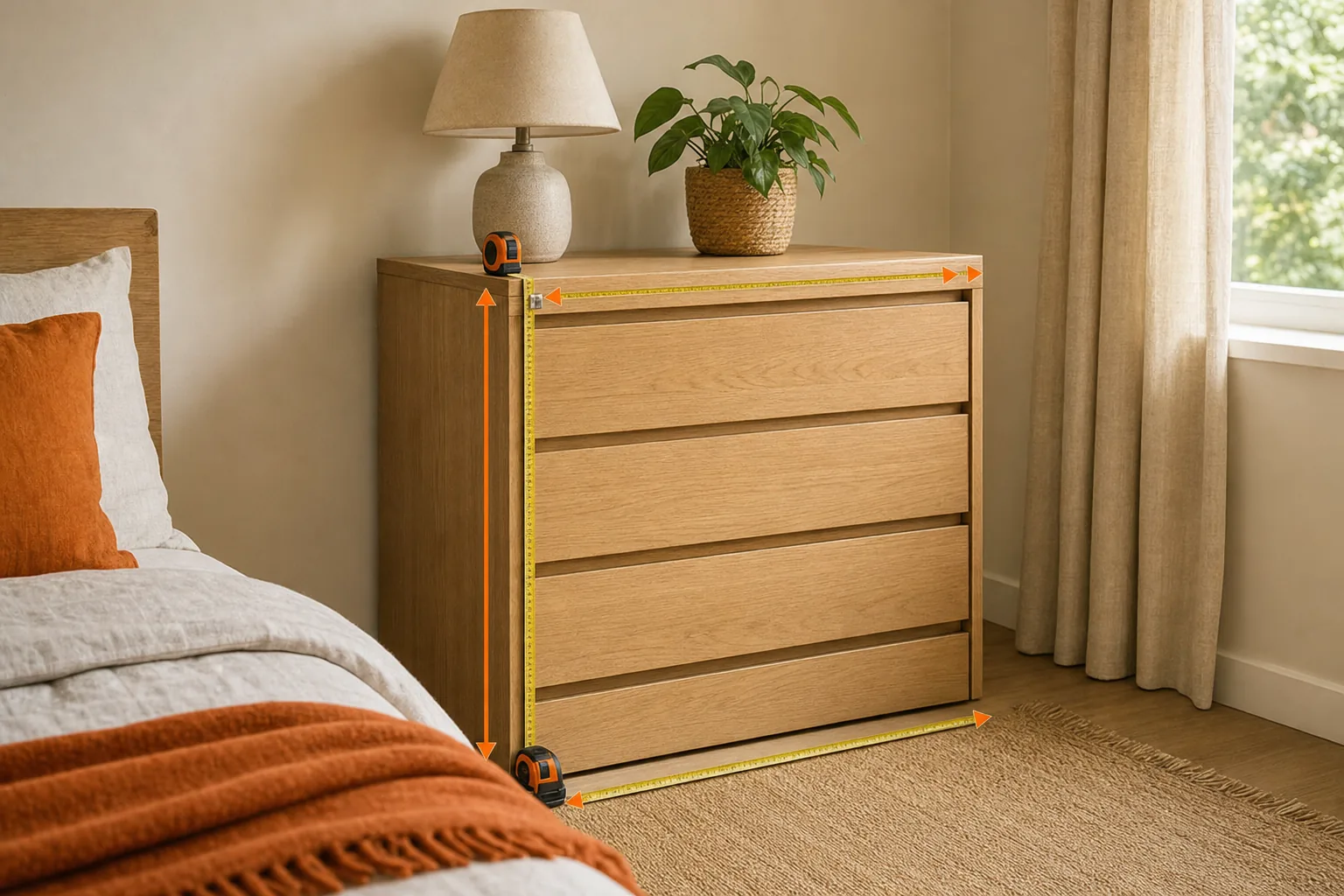
Typical chest of drawers sizes and how they vary
There isn’t one fixed size for every chest. A South African market snapshot puts common dimensions at roughly 100 cm high, 85 cm wide and 48 cm deep. Treat that as a useful starting point, not a rule. A slim unit or a tall design can sit well outside those figures.
Width often shapes the choice first. Several local examples are 60 cm wide, while the median width in the market snapshot is 85 cm. So a 60 cm chest can be handy in a narrow spot, but it’s not a good stand-in for the width most models have.
Individual examples show how far sizes can differ. The GB4+1 Chest of Drawers is 91 cm wide, 90 cm high and 48 cm deep. The GB6 Chest of Drawers has the same width and depth, but stands 130 cm tall. A tall chest is narrower at 65 cm and shallower at 34 cm.
Those differences affect where a chest works. A narrow, shallow model may leave more walking room in a compact bedroom. A wider unit can give you more surface area, while a taller chest uses more wall height without taking up extra floor width.
Furniture is a broad term for movable objects used to support activities or store items. For a bedroom chest, though, the useful comparison is more specific: measure the spot you have and match it to the outside dimensions of the exact unit.
Material and finish also affect the look and care needs, even when the measurements match. The local examples include teak and other wood designs, along with a wood-frame chest with mixed-material drawer fronts. Check the item’s own description for its material and finish rather than assuming every wooden-looking chest is made the same way.
When you compare sizes, write each model’s height, width and depth in the same order. That small step makes a slim option easier to compare with a standard-width or tall design.
Low, standard-height and tall chests: what the height means
Height affects reach, sightlines and the space left above the furniture. There’s no single height that makes a chest officially “standard”. In the local examples, heights range from 81 cm to 130 cm, with 100 cm as the middle value in the market snapshot.
A lower chest can keep the wall above it open. That can help in a small room where you want to use the wall for another purpose. The 81 cm Eclectic chest and the 86 cm Oriental-rustic apothecary chest are examples of lower designs. Their listed heights don’t tell you how much each drawer holds, so check the layout too.
A chest around 90 to 110 cm high can be a useful middle ground for many bedrooms. The GB4+1 is 90 cm high, while the GB5+1 reaches 110 cm. These are examples, not a set size standard. Your own reach and the room’s layout should guide the choice.
Tall chests use more vertical space. The GB6 is 130 cm high, and a tall chest measures 122 cm. A tall shape may suit a narrow wall, but check that you can comfortably reach the top drawers. If a child will use the chest, make sure the drawers they need are within easy reach.
Think about what will sit on top, too. A lamp or a framed photo needs room above the chest and should be easy to reach. If you plan to place the unit beneath a window, measure from the floor to the sill. Then leave room for curtains or handles if they sit near the furniture.
Ergonomics looks at how people interact with objects and spaces. For your chest, the plain test is simple: can you reach the drawer you use most without stretching or leaning awkwardly?
Choose height by the person using the chest and the items inside it. A tall unit saves floor width, but only if its upper drawers are still comfortable to use.
Width, drawer layout and storage capacity
Width gives you a quick sense of the chest’s footprint, but it doesn’t tell the full storage story. Two units of similar width can have different drawer counts or drawer shapes. Look at the layout and consider the items you plan to store.
A single column of drawers creates a narrower front. A wider chest may place drawers side by side or use a mix of large and small drawers. Small drawers can help sort socks or accessories. Larger drawers may suit folded garments or linens, but check their inside measurements if those items need to fit neatly.
Examples show why drawer count matters. The Oriental-rustic apothecary chest is 90 cm wide and has nine drawers in a three-by-three layout. The GB6+1 is 91 cm wide and 130 cm high. Similar widths don’t mean the two units offer the same kind of storage.
Use a tape measure on a folded item you plan to store. Measure its width and depth, then compare those figures with the drawer’s internal size if the seller provides it. For bulkier items, check the drawer opening as well. An item might fit inside but still be awkward to lift over the drawer front.
A simple estimate of storage volume uses the inside width, inside depth and inside height of a drawer. Multiply those measurements to get an approximate volume in cubic centimetres. Add the drawer volumes for an approximate total. This is only an estimate; the drawer’s shape and usable space can change the result.
For a quick choice, use this table to match the outside size and layout to the job. It compares examples from local listings, not every available chest.
| Example | Outside dimensions | Layout detail | What to check for your room |
|---|---|---|---|
| 600mm Wide Chest of Drawers GM4 | 60 cm wide | Width is given | Measure the wall space and check height and depth on the item page |
| GB4+1 Chest of Drawers | 90 cm high × 91 cm wide × 48 cm deep | Model name indicates a drawer configuration | Confirm the internal drawer sizes for your stored items |
| Oriental-rustic apothecary chest | 86 cm high × 90 cm wide × 41 cm deep | Nine drawers in a three-by-three grid | Check whether the smaller compartments suit what you want to sort |
Don’t guess the weight limit from the outside size or the number of drawers. Ask the retailer for the load limit if you plan to store heavy items. That helps you avoid putting more weight in a drawer than it was designed to hold.
We include product dimensions on the Lagos listing so you can compare a real model with your own measurements. Browse our chest of drawers range when you’re ready to check current options and their listed specifications.
Depth, drawer access and clearance around the chest
Depth measures how far the chest projects from the wall. It also affects how much room a drawer needs when you pull it open. A shallow chest can preserve walking space, while a deeper one may provide more room for folded items.
Local examples show a wide spread. The GB4+1 is 48 cm deep, while a shallower example measures 34 cm deep. The shallower piece may suit a tighter passage, but depth alone doesn’t tell you its drawer capacity. Compare the inside measurements and layout before deciding.
Start by measuring the wall space where the chest will stand. Then measure from that wall to the nearest obstacle, such as a bed or door. Mark the full depth on the floor with masking tape or a line of paper. This gives you a clear picture of how much walking room will remain.
Next, account for the drawer as it opens. Measure from the back wall to the front edge of the fully extended drawer, if that figure is available. If it isn’t, use the chest depth as a starting point and leave enough space to stand in front while you reach inside. Don’t assume you can open a drawer fully just because the chest fits against the wall.
Check nearby doors and furniture. A bedroom door may swing into the chest. A wardrobe door or bedside table may block a drawer from opening. Try the same movement with the tape outline in place. You’ll spot a clash before delivery, not after assembly.
Also look for details that change the fit. Skirting boards can keep a chest from sitting close to the wall. Handles add a little to the front projection. A raised floor edge or uneven spot can affect how the unit sits.
Leave enough space to walk past without turning sideways. There’s no one clearance figure that suits every room, so test the route you use each day. If the bedroom is small, compare a shallower model with a wider one before giving up floor space.
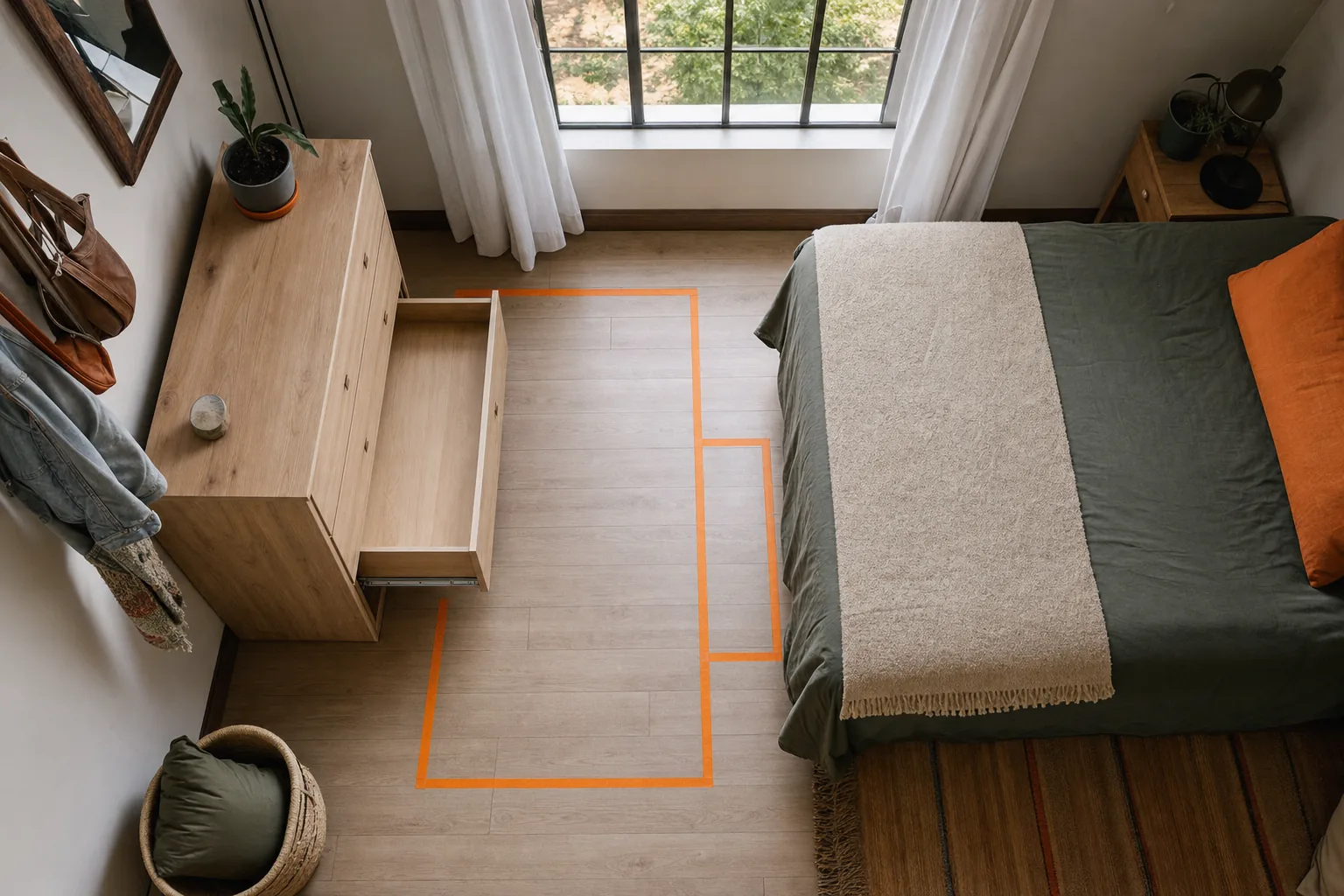
How to check that a chest will fit your room and delivery route
A chest has to fit the room, but it also has to reach the room. Measure both before ordering. A common mistake is to check only the wall space and forget the front door, passage or stair turn.
Use this check in order:
- Measure the final spot. Note the usable wall width and floor depth. Include skirting boards or other features that stop the chest sitting flush.
- Check the full height. Measure from the floor to any window sill, shelf or sloped ceiling above the unit.
- Mark drawer space. Use tape on the floor to show the chest’s footprint. Add the space needed to stand in front and open a drawer.
- Trace the delivery route. Measure doorways and passage widths. Check stairs, tight corners and lift openings if you live in a block of flats.
- Confirm what the measurements describe. Ask whether the product page gives the assembled size, carton size or both.
Flatpack furniture arrives in pieces, so the carton dimensions may be different from the assembled chest. Find out the longest carton measurement and compare it with the narrowest point on your route. A carton may pass through a doorway at an angle, but don’t rely on that without measuring the turn.
If you’re comparing self-assembly choices, check what support comes with the furniture. Me&Co Furniture includes assembly hardware and step-by-step instructions, with video guides for the build. Those details can help you plan the assembly space and know what to have ready before the cartons arrive.
We also suggest checking who will assemble the unit and where. Clear a flat area with room to sort the parts. Keep the instructions nearby, and follow the steps in order. Don’t force a piece that seems misaligned; check the diagram before tightening it.
Our flatpack bedroom furniture guide shares more about planning for self-assembly. If space is very tight, make the route measurements before placing an order and keep them beside the product dimensions.
A final check: compare the assembled width, height and depth with your room notes, then compare the carton size with the delivery path. Both need to work.
Frequently asked questions
What is the standard size of a chest of drawers?
There isn’t one fixed standard size for every chest. A South African market snapshot puts a typical model near 100 cm high, 85 cm wide and 48 cm deep, but individual pieces vary. Use those figures as a rough guide, then check the exact height, width and depth on the product listing.
How deep should a chest of drawers be?
A useful depth depends on the items you’ll store and the space in front of the chest. Local examples include a 34 cm-deep tall chest and models around 48 cm deep. Measure your folded clothes or linens, then check the drawer’s inside depth and the room needed to open it.
How much space do I need in front of a chest?
Leave enough room to open the drawers and stand in front of them. The amount varies with drawer depth and your room layout. Mark the chest’s footprint on the floor, then test the drawer opening and walking path. Check nearby doors and furniture so they don’t block access.
How do I measure a chest of drawers for delivery?
Measure the narrowest doorway, passage or turn on the route to the room. Compare those measurements with the carton size, not only the assembled chest size. For flatpack furniture, ask which carton is longest and check stairs or lift openings as well.
How can I estimate drawer storage space?
Measure the usable inside width, depth and height of each drawer. Multiply the three numbers to estimate volume in cubic centimetres. Treat the result as an estimate, since drawer shape and fittings can reduce usable space. Ask the retailer about load limits separately.
Conclusion
Choose a chest by its full outside size, drawer layout and clearance, not by width alone. Measure the room and delivery route, then compare those notes with the exact product listing. If you’d like to check locally made flatpack options, explore Me&Co Furniture’s range and its assembly support before you decide.
